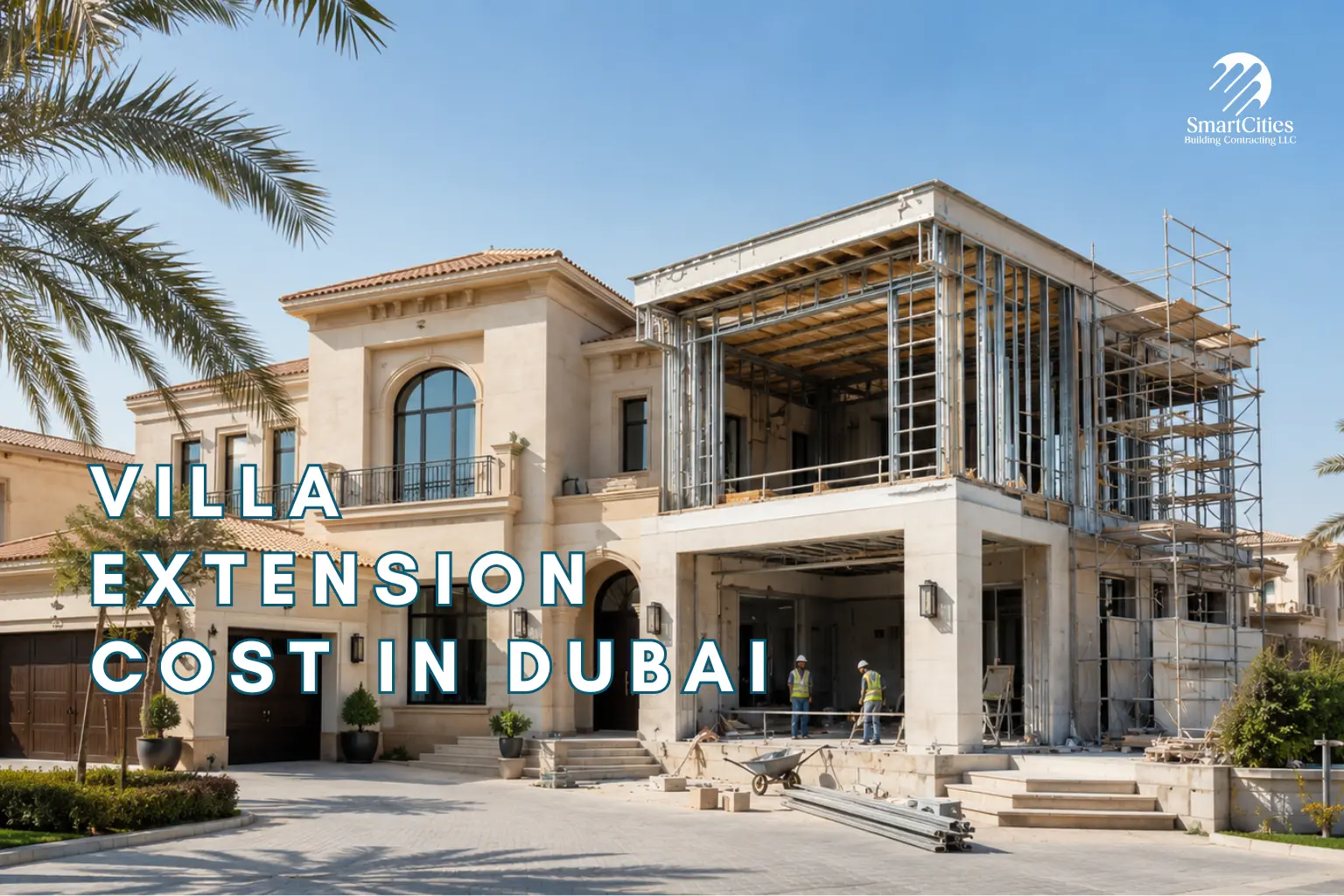
Villa extension cost in Dubai is something many homeowners start thinking about when their villa no longer feels suitable for the way they live today.
Maybe the kids are growing and need their own rooms. Maybe working from home has made a proper home office necessary. Or maybe the kitchen that once worked perfectly now feels too small, crowded, and difficult to use every morning.
At that point, the real question is not only whether you should extend your villa. It is how much the extension will cost, what approvals are required, and whether extending your current home makes more sense than selling it and buying a bigger property.
This guide breaks it down clearly, with practical 2026 cost details for the most common villa extension types in Dubai — from a simple ground-floor room addition to a complete second-floor extension.
The case for extending rather than moving
Dubai’s villa market has moved sharply. Comparable properties in Arabian Ranches, Dubai Hills Estate, The Springs, and Jumeirah Village Circle are selling at prices that make upgrading expensive, especially once you factor in 4% DLD transfer fees, agent commissions, and the cost of settling into a new community.
A well-executed villa extension typically costs 40–60% less per square foot than buying equivalent additional space through relocation. If your existing plot has unused GFA allowance and your foundation can carry the additional load, extending is almost always the more efficient financial decision.
Before you budget: the two things that determine feasibility
1. Plot coverage and GFA ratio
Every Dubai villa community has a maximum plot coverage ratio — typically capped at 60–70% of total plot area — and a maximum Gross Floor Area (GFA) ratio that limits how much total built-up area your plot can accommodate across all floors.
Before any costing conversation is meaningful, you need to know your current BUA versus your permissible GFA. A structural and planning consultant can pull this from your title deed and the relevant Development Control Regulations (DCR) in about a day. If your villa is already at or near the GFA cap, a second-floor addition may not be permitted regardless of budget.
For reference:
- Low-density communities (Emirates Hills, Al Barari) — lower GFA ratios to preserve the character of the area
- Mid-range communities (Dubai Hills Estate, Jumeirah Golf Estates) — moderate GFA allowances
- Higher-density areas (MBR City, Al Furjan) — more built-up area permitted within the same footprint
2. Structural capacity of the existing build
A second-floor addition requires the existing ground-floor walls, columns, and foundations to carry the new load. Not all villas built in the 1990s and early 2000s were designed with future vertical expansion in mind. A licensed structural engineer must assess the existing structure before any design begins. If strengthening is required, that cost needs to be factored into the budget from the start — not discovered mid-construction.
Villa extension types and 2026 cost ranges
All figures below reflect Dubai market conditions in 2026 at standard to mid-range specification unless noted. Costs exclude land, existing structural remediation where required, and temporary accommodation during works.
Single-room addition (ground level)
The most straightforward extension type: adding a bedroom, home office, gym, or utility room as a ground-level structure connected to the existing villa. Typical size: 25–50 sqm.
| Specification | Cost range | Per sqm |
|---|---|---|
| Standard finish | AED 200,000 – 350,000 | AED 6,000 – 8,500 |
| Mid-range finish | AED 350,000 – 550,000 | AED 8,500 – 12,000 |
| Luxury finish | AED 550,000 – 900,000+ | AED 12,000 – 15,000+ |
Included: civil structure, MEP connections (extending existing runs), internal finishes, joinery, lighting, AC. Not included: furniture, exterior landscaping restoration around the new footprint.
⏱ Timeline: 10–16 weeks from design sign-off to handover.
Open-plan living extension (ground level)
Removing or partially opening internal walls to expand a living area, or extending the living/dining space outward into the garden. The most popular extension type in communities like Arabian Ranches and The Springs, where original developer layouts keep the kitchen and living areas in separate enclosed rooms.
| Scope | Cost range |
|---|---|
| Internal wall removal + open-plan conversion only | AED 80,000 – 180,000 |
| Ground-floor structural extension (new sqm added) | AED 300,000 – 700,000 |
| Combined: conversion + extension with bi-fold doors | AED 450,000 – 900,000 |
⚠️ Important: Internal wall removal triggers a structural engineer’s sign-off and Dubai Municipality approval even without adding new floor area. Do not proceed without this — unapproved structural changes can result in forced restoration at your expense.
⏱ Timeline: 8–14 weeks for combined scope.
Master suite or bedroom wing addition
Adding a master bedroom with en-suite, walk-in wardrobe, and private access — the single most in-demand villa room addition in Dubai, driven by families where the original layout clusters all bedrooms on one corridor.
| Specification | Cost range |
|---|---|
| Standard (650–850 sqft addition) | AED 350,000 – 500,000 |
| Mid-range (custom joinery, premium bathroom) | AED 500,000 – 800,000 |
| Luxury (bespoke finishes, walk-in wardrobe, private terrace) | AED 800,000 – 1,300,000 |
A master suite addition at mid-range specification consistently delivers strong ROI in owner-occupier communities because it directly addresses what buyers look for at the top of the villa market.
⏱ Timeline: 12–18 weeks.
Second-floor addition
Adding an entirely new floor to an existing single-storey or ground-plus-one villa. Dubai’s updated building regulations allow villas to extend upward to 100% on the second floor within the permissible GFA, with a minimum 1.5-metre setback from boundaries.
This is the highest-cost extension type and requires the most thorough upfront planning — but it delivers the most significant increase in liveable space without changing the villa’s garden footprint.
| Specification | Cost range | Per sqft |
|---|---|---|
| Standard (3–4 bedrooms, basic bathrooms) | AED 600,000 – 900,000 | AED 500 – 700 |
| Mid-range (full fit-out, custom joinery) | AED 900,000 – 1,300,000 | AED 700 – 1,000 |
| Luxury (premium materials, bespoke design) | AED 1,300,000 – 2,000,000+ | AED 1,000 – 1,500+ |
Note: The structural assessment and any required foundation or column strengthening are separate from the figures above. A structural upgrade can add AED 80,000–250,000 to a second-floor project depending on the existing build. Always get this scoped before signing any construction contract.
⏱ Timeline: 16–28 weeks from design sign-off to handover.
Outdoor and covered-living extension
Garden rooms, covered terraces, pergola structures, pool cabanas, and majlis extensions. Among the fastest-growing extension categories in Dubai as outdoor living continues to gain importance in luxury villa communities.
| Type | Cost range |
|---|---|
| Pergola or shaded terrace (structural) | AED 60,000 – 180,000 |
| Garden room / enclosed outdoor living room | AED 150,000 – 400,000 |
| Pool cabana with bathroom and kitchenette | AED 200,000 – 500,000 |
| Full outdoor majlis (insulated, AC, full fit-out) | AED 300,000 – 700,000 |
⏱ Timeline: 6–14 weeks depending on scope.
Approval costs and process: what to budget
Every extension that increases the villa’s Built-Up Area (BUA) or involves structural changes requires formal approval before a single brick is laid. Skipping this step can result in fines of AED 10,000 or more, stop-work orders, forced demolition at your cost, and complications when selling — the DLD flags unapproved modifications during title transfer.
Stage 1 — Developer NOC
If your villa is in a master developer community, the NOC from that developer is the mandatory first step. Dubai Municipality will not accept a building permit submission without it.
- Emaar communities (Arabian Ranches, Dubai Hills Estate, The Springs, The Meadows, Emirates Hills): Submit via the Emaar Community Portal. In 2026, Emaar’s Design Review Committee (DRC) reviews all structural and external modifications. GFA fees apply for any increase in built-up area.
- Nakheel communities (Palm Jumeirah, Jumeirah Islands, Jumeirah Park, JVC, JVT): Submit to Nakheel Community Management. Palm Jumeirah applications are reviewed by Trakhees, not DM.
- DAMAC communities: Submit to DAMAC Facilities Management. Review typically takes 2–4 weeks for standard extensions.
Developer NOC fees typically range from AED 5,000–25,000 for residential extensions, plus GFA charges where applicable.
Stage 2 — Dubai Municipality Building Permit
Once the developer NOC is in hand, your DM-registered consultant submits architectural, structural, and MEP drawings for a building permit. DM fees are calculated at approximately AED 50 per sqm for residential projects, with additional charges for specific elements.
| Area / Authority | Total approval & consultant fees | Typical timeline |
|---|---|---|
| Standard DM communities | AED 15,000 – 60,000 | 6–10 weeks total |
| Trakhees-regulated (Palm Jumeirah, Jumeirah Bay Islands) | AED 50,000 – 150,000 | 8–14 weeks total |
💡 Tip: Start the approval process concurrently with detailed design work — not after drawings are finalised. This saves 6–10 weeks from your overall project timeline.
Community-specific rules and cost premiums
The community your villa is in affects both what you are permitted to build and what it will cost. Here are the key considerations for Dubai’s major villa communities:
- Arabian Ranches, The Springs, The Meadows (Emaar): Traditional Arabian architecture guidelines regulate exterior materials, roof styles, and colour palettes. Extensions must match the original villa’s character. A contractor should present DRC submission drawings before ordering any materials.
- Dubai Hills Estate (Emaar): More flexible modern guidelines, but thorough DRC review. Higher land values mean extensions here typically run 10–15% above communities like JVC at equivalent spec.
- Palm Jumeirah (Nakheel / Trakhees): Permit fees are significantly higher under the Trakhees schedule. Access logistics add cost. Projects here typically run 15–25% above mainland communities at equivalent specification.
- Emirates Hills (Emaar): Low-density community with strict GFA limits. Second-floor additions are possible but subject to tight design review. Rear setback requirement is 3 metres vs the standard 1.5 metres.
- Jumeirah Village Circle (Nakheel): More permissive community guidelines. NOC process is relatively straightforward. A practical choice for extension projects given plot sizes and developer flexibility.
- Jumeirah Park, Jumeirah Islands (Nakheel): Nakheel community guidelines apply. Extensions connecting indoor and outdoor space are popular given the plot layouts in these communities.
What a complete extension costs: three real examples
Example 1 — Single bedroom addition, Arabian Ranches
- Scope: 40 sqm ground-floor bedroom and en-suite
- Specification: Mid-range (tiled bathroom, custom wardrobe, standard AC)
- Construction cost: AED 380,000
- Design and engineering fees: AED 35,000
- Emaar NOC and DM permit fees: AED 22,000
- Total project cost: approx. AED 437,000
- Timeline: 14 weeks from design sign-off
Example 2 — Full second floor, Dubai Hills Estate
- Scope: New floor with 3 bedrooms, 2 bathrooms, study, terrace (approx. 210 sqm)
- Specification: Mid-range to luxury
- Structural assessment and foundation upgrade: AED 120,000
- Construction cost: AED 1,050,000
- Design and engineering fees: AED 85,000
- Emaar NOC and DM permit fees: AED 48,000
- Total project cost: approx. AED 1,303,000
- Timeline: 22 weeks from design sign-off
Example 3 — Covered outdoor living extension, JVC
- Scope: 60 sqm enclosed garden room with AC, full fit-out, bi-fold doors to garden
- Specification: Mid-range
- Construction cost: AED 290,000
- Design and engineering fees: AED 18,000
- Nakheel NOC and DM permit fees: AED 14,000
- Total project cost: approx. AED 322,000
- Timeline: 10 weeks from design sign-off
Hidden costs most quotes don’t include
Even detailed contractor quotes often omit line items that add up quickly. Ask specifically about:
- Temporary works and site protection — hoarding, temporary weatherproofing where the new structure connects to the existing villa, and dust management. Especially important if the family remains in residence during works.
- MEP connection runs — extending electrical, plumbing, and AC systems from the existing plant to the new structure. Where the existing MEP is undersized, upgrading it to handle the additional load is a separate cost.
- Landscaping restoration — construction access damages grass, paving, and planted areas around the new footprint. Restoring the garden to its pre-works condition is rarely included in the base extension quote.
- Snagging and defects liability — ask what the defects liability period is and what it covers. A reputable contractor provides a minimum 12-month workmanship warranty with a formal snagging process at handover.
- 10–15% contingency — regardless of how detailed the quote, always hold a contingency for unforeseen structural conditions, material lead times, or design changes. This is standard practice on all Dubai construction projects.
Extension vs renovation vs buying bigger: the honest comparison
| Villa extension | Buy a larger villa | Renovate existing villa | |
|---|---|---|---|
| Cost per additional sqft | AED 500–1,500 | AED 1,500–4,000+ (incl. DLD, agent, setup) | N/A — no new sqm added |
| Disruption | Moderate (3–6 months) | High (move, settle, new community) | Low–moderate |
| Approval complexity | Medium | None (buyer side) | Low–medium |
| Property value uplift | 10–20% in strong communities | Market-dependent | High for kitchens & bathrooms |
| Keeps your community | Yes | No | Yes |
For families committed to their community, extending is almost always the more efficient outcome — provided the GFA headroom exists and the structural assessment comes back clean.
How Smart Cities UAE manages villa extension projects
At Smart Cities UAE, villa extensions are managed as a single-contractor, fully integrated scope. That means design, structural engineering coordination, developer NOC submission, DM building permit, construction, MEP works, interior fit-out, and final snagging — all under one contract and one point of accountability.
Working with separate architects, structural engineers, approvals consultants, and builders creates handoff risk at every stage. A single integrated contractor eliminates the most common sources of cost overruns and delays:
- Approval submissions rejected due to incomplete cross-discipline coordination
- MEP contractors arriving to find the structural work hasn’t left adequate clearances
- Fit-out teams working from design drawings not updated to reflect what was actually built
We have been delivering villa construction, renovation, and fit-out projects across Dubai since 2008 and hold a full Dubai Municipality contractor licence covering all building permit categories.
Frequently asked questions about villa extension costs in Dubai
How much does a villa extension cost in Dubai in 2026?
A single-room ground-floor addition typically ranges from AED 200,000 to AED 550,000 at mid-range specification. A full second-floor addition ranges from AED 600,000 to AED 2,000,000+ depending on size, specification, and whether structural strengthening is required. Per-sqft rates run from AED 500 (standard) to AED 1,500+ (luxury). These figures exclude approval and consultant fees, which add AED 15,000–60,000 for standard DM projects.
Do I need approval for a villa extension in Dubai?
Yes, without exception. Any extension that increases Built-Up Area (BUA) or involves structural changes requires a developer NOC (Emaar, Nakheel, DAMAC, or the relevant community developer) and a Dubai Municipality Building Permit. In Palm Jumeirah and other Trakhees-regulated zones, Trakhees approval replaces the DM permit. Unapproved works can result in fines of AED 10,000+, stop-work orders, and forced demolition at the homeowner’s cost.
How long does a villa extension take in Dubai?
A single-room addition takes 10–16 weeks. An open-plan conversion plus extension takes 8–14 weeks. A full second-floor addition takes 16–28 weeks. The approval phase — developer NOC plus DM Building Permit — adds 6–10 weeks and should run concurrently with detailed design work, not sequentially after drawings are finalised.
Can I add a second floor to my Dubai villa?
In most communities, yes — subject to your plot’s GFA ratio, community design guidelines, and a structural assessment confirming the existing foundation can carry the new load. Dubai’s updated regulations allow second-floor extensions up to 100% within the permissible GFA, with a minimum 1.5-metre setback. A licensed structural engineer must confirm load capacity before design begins.
Is a villa extension worth it in Dubai?
Generally yes — provided your plot has unused GFA allowance, the structural assessment is clean, and the specification matches the community standard. A well-executed extension costs 40–60% less per sqft than buying equivalent additional space through relocation (once DLD fees, agent costs, and moving expenses are factored in). Extensions in strong communities typically deliver a 10–20% uplift in property value.
What is the difference between a villa extension and a villa renovation in Dubai?
A villa renovation works within the existing footprint — updating finishes, replacing fixtures, and reconfiguring layouts within existing walls. An extension adds new floor area or covered space. Both may require approvals, but extensions always trigger a Building Permit. Renovations require a permit only where structural walls are affected or MEP systems are materially changed.
Smart Cities Building Contracting LLC | Est. 2008 | Al Quoz Industrial Area 4, Dubai | Licensed by Dubai Municipality