
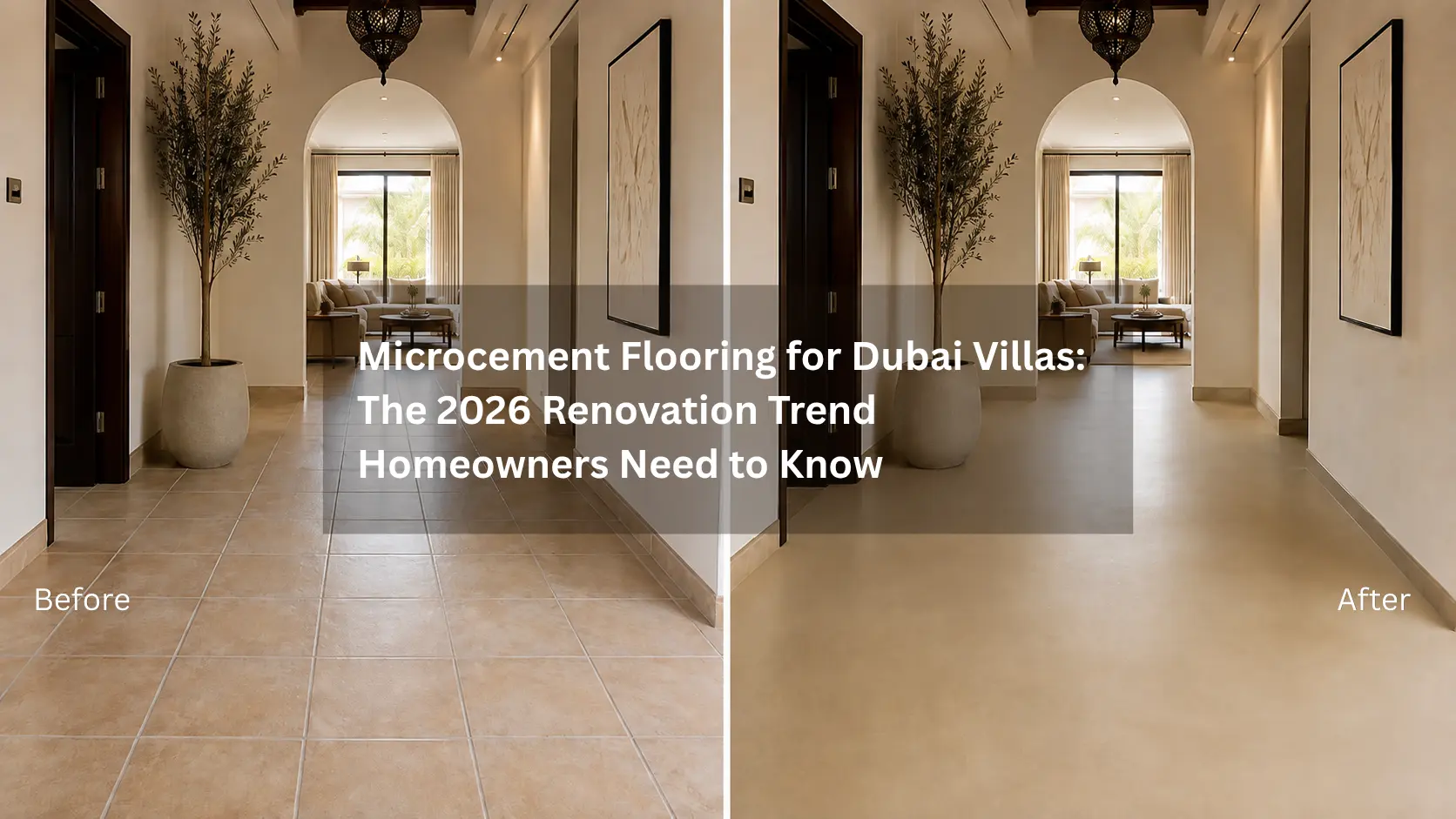
Microcement Flooring for Dubai Villas: The 2026 Renovation Trend Homeowners Need to Know
Microcement flooring Dubai has become one of the fastest-growing villa renovation trends of 2026. If you’ve been researching villa renovation ideas this year, you’ve probably come across this material appearing again and again in high-end projects. What was once a niche finish reserved for boutique hotels and designer showrooms has become one of the fastest-growing flooring choices for Dubai villa renovations — and for good reason.
Microcement offers a seamless, European-luxury look, applies directly over most existing tiled floors without demolition, and holds up well against Dubai’s heat and humidity swings. For homeowners weighing their options against traditional porcelain, natural stone, or engineered wood, it’s worth understanding exactly what microcement is, where it works best, and what it costs before you commit.
What Is Microcement Flooring?
Microcement is a thin, cement-based coating — typically just 2 to 3 millimetres thick — applied in multiple layers over an existing surface to create a smooth, continuous, joint-free finish. Unlike traditional cement screed, it’s blended with polymers and fine aggregates that allow it to be applied thinly, sealed, and finished to a polished or matte look across floors, walls, countertops, and even bathroom surfaces. As interior design publications have noted, its rise in popularity is closely tied to homeowners wanting a concrete aesthetic without concrete’s maintenance drawbacks.
The result is a monolithic surface with no grout lines, no visible seams, and a soft, tactile texture that reads as contemporary and minimal — a style that has become closely associated with the open-plan, warm-neutral interiors currently trending across Dubai villa renovations.
Why Microcement Is Gaining Ground in Dubai Villas
1. No Demolition Required
One of the biggest practical advantages is that microcement can usually be applied directly over existing tile, provided the surface is structurally sound and properly prepared. This removes the need for tile removal, which is typically one of the messiest, noisiest, and most time-consuming parts of a villa flooring upgrade. For homeowners trying to minimise disruption — especially in occupied villas — this alone can shorten a renovation timeline significantly.
2. Performs Well in Dubai’s Climate
Dubai’s flooring materials need to handle large temperature swings between air-conditioned interiors and hot, humid exteriors, along with constant exposure to sand and dust. Properly sealed microcement is highly resistant to cracking from thermal movement, doesn’t harbour dust in grout lines the way tiled floors do, and is straightforward to clean — a practical advantage in a climate where floors are cleaned frequently.
3. Cost Advantage Over Imported Porcelain
Large-format imported porcelain slabs have been a popular high-end choice in Dubai villas, but they come with a premium price tag tied to shipping and material costs. Microcement typically costs 30 to 40% less than imported large-format porcelain while still delivering a comparable seamless, luxury aesthetic — making it an attractive option for homeowners who want a premium look without the premium import cost.
4. Design Versatility
Microcement isn’t limited to floors. The same finish can be extended up walls, into bathrooms, onto kitchen countertops, and even onto staircases, creating a continuous surface that visually enlarges a space — a detail that pairs naturally with the open-plan layouts currently dominating villa renovations across Dubai’s established communities.
Colour and Finish Options
Part of microcement’s appeal is how customisable the final look can be. Unlike tile or stone, which are limited to the exact slabs or batches available, microcement is mixed and pigmented on-site, giving homeowners much finer control over the finished tone. Popular choices in Dubai villas tend to lean toward warm neutrals — soft greys, sandy beige, and off-white tones that complement natural light and pair well with wood, brass, and stone accents already common in local interior design.
Beyond colour, the surface finish itself can be adjusted. A matte, chalky texture suits bedrooms and living spaces where a softer, more tactile feel is desired, while a polished or lightly waxed finish creates more reflectivity and works well in kitchens, bathrooms, and entryways where a sharper, more formal look is preferred. Some homeowners also opt for a subtle trowel-marked texture rather than a perfectly flat surface, adding a handcrafted quality that reads as more artisanal than industrial. Discussing finish samples with your contractor before application is worthwhile, since the final result can vary noticeably depending on trowel technique and the number of coats applied.
Where Microcement Works Best in a Villa

- Living and dining areas: The seamless finish suits open-plan layouts and creates visual continuity between spaces.
- Kitchens: Microcement countertops and flooring pair well together for a cohesive, contemporary kitchen renovation.
- Bathrooms: A waterproofed microcement finish eliminates grout lines that are prone to mould and staining in humid conditions.
- Home offices and bedrooms: The soft, matte texture works well in quieter, more residential spaces.
- Staircases and hallways: A continuous surface across transitional spaces reduces the visual clutter of multiple material changes.
High-traffic outdoor areas exposed to direct sun and pool chemicals require a specific exterior-grade microcement system and additional UV-stable sealing, so it’s worth confirming a contractor’s outdoor application experience separately from their interior work.
What to Budget For
Microcement pricing in Dubai varies based on surface preparation needs, the number of coats applied, sealing quality, and whether the work extends to walls or countertops in addition to floors. As a general guide, homeowners should expect microcement to sit below imported porcelain but above standard ceramic tiling, with the exact figure depending on the condition of the existing surface and the finish selected. For a broader breakdown of how flooring fits into overall renovation spend, see our villa renovation cost guide. Getting a site assessment is the only reliable way to get an accurate number, since surface prep requirements can vary significantly from villa to villa.
Things to Confirm Before You Commit
Microcement is a skill-dependent finish — the quality of the final surface depends heavily on correct substrate preparation and application technique. Before starting a microcement project, homeowners should confirm:
- Whether the existing floor surface is suitable, or requires levelling first
- The sealing system being used, and its warranty against cracking or staining
- Maintenance requirements, including recommended cleaning products
- Whether the applicator has documented experience with microcement specifically, rather than general tiling
Microcement Flooring Dubai: Is It Right for Your Villa?
Microcement suits homeowners who want a seamless, contemporary finish, are working with an open-plan or semi-open layout, and want to avoid the cost and disruption of a full tile replacement. It’s less suited to homeowners who prefer the classic look of natural stone or large-format tile, or who are working with a substrate that needs significant structural repair before any finish can be applied.
As with any villa renovation decision in Dubai, the right choice depends on your layout, budget, and how the space will be used day to day. A walkthrough with an experienced renovation team is the best way to confirm whether microcement is the right fit for your specific villa before committing to materials.
Frequently Asked Questions
Does microcement crack over time?
Properly applied and sealed microcement is designed to flex slightly with minor substrate movement, which helps prevent the fine cracking seen in poorly prepared installations. Quality of application and substrate preparation are the biggest factors in long-term durability.
Can microcement be applied over existing tiles?
In most cases, yes, provided the existing tiles are securely bonded and structurally sound. A contractor will typically assess the surface first to confirm it doesn’t need levelling or repair before application.
How long does a microcement flooring project take?
Because it avoids tile demolition, microcement application is generally faster than a full tile replacement, though exact timelines depend on the size of the area and the number of coats and curing time required between layers.
Is microcement suitable for bathrooms and wet areas?
Yes, with the correct waterproofing and sealing system designed for wet areas. This should be specified and confirmed with your contractor before work begins.
How do you maintain microcement floors?
Microcement floors are generally low-maintenance, requiring regular cleaning with pH-neutral products and periodic resealing to maintain water resistance and finish over time.
Considering microcement flooring in Dubai or another flooring upgrade for your villa renovation? Get in touch with our team for a site assessment and tailored recommendation for your space.